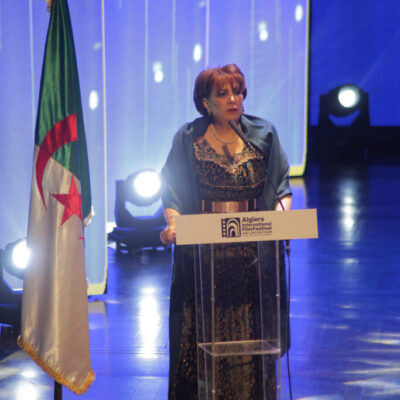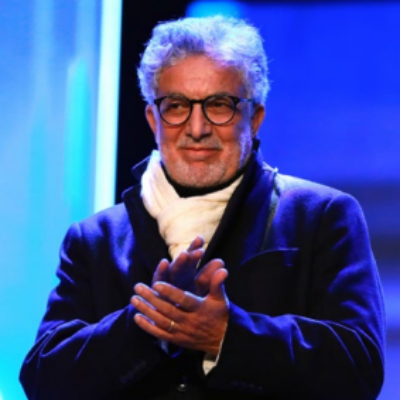
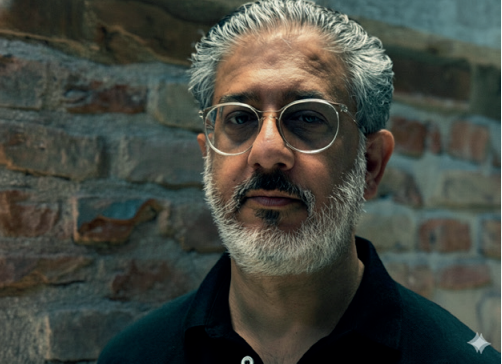
The Algiers International Film Festival (AIFF), at the close of its 12th edition, honors Palestinian filmmaker Hanna Attallah, founder and artistic director of « Filmlab Palestine. »
Since its launch in 2014, the institution has continued to expand its activities, programs, and vision, including capacity development, production support, and co-production. It also founded « Palestinian Cinema Days, » which has become an international festival attracting premiere screenings of notable films. In addition, Filmlab Palestine pays great attention to training the new generation through workshops aimed at children, while simultaneously seeking to strengthen and document the narrative of the indigenous people who hold the right to the land. Its ambition extends beyond the limits of individual film production to reach the construction of a complete and sustainable Palestinian cinematic ecosystem, encompassing production, screening, audience development, and the development of necessary infrastructure.
1/ After 25 years, you return to Algiers as an honoree. How do you describe your feeling about this return, and what impact did your Algerian experience have on your artistic vision of cinema?
Indeed, I remember my visit to Algeria, I think in 1999 or 2000, during the Tebessa International Festival. At that time, I was still a student at the Higher Institute of Cinema at the Academy of Arts in Egypt. My third-year graduation project was screened at the Festival, and I was present to follow the event. Before moving to Tebessa, we spent two days in Algiers and stayed at the « El Djazair » hotel, where this stay brought back memories of my student days and our enthusiasm as cinema students.
The honoring by Algeria and the Festival is a great honor and a wonderful surprise, not only for screening my project but because the Festival united us with the cinema of revolution and struggle, just as it brought together Palestinian and Algerian cinema. I felt a shared consciousness among us as Palestinian filmmakers, and that this experience represented a part of the Algerian struggle in cinema and art. There were many similarities between our experiences, both artistically and politically, which made the trip a rich and deeply impactful experience for me.
2/ How do you view the role of cinema in strengthening resistance and safeguarding the Palestinian narrative for future generations?
The Palestinian cause is a humanitarian cause par excellence, and any liberal and humane person supports it. That is why, in the seventies, there were many international directors who participated in forming what we can call Palestinian cinema during the time of the PLO, including Jean-Luc Godard from France, in addition to directors from Algeria, Japan, and other countries, who worked with Palestinians to produce images, documentation, and convey the Palestinian narrative to the world.
Currently, the image has become the weapon of the era, especially with the spread of social media, and with the presence of continuous attempts at distortion practiced against Palestinians and their cause, and even against Palestinians as individuals. If we look at Western cinematic production, we find that the Palestinian image is often outside the scope of direct control, which makes the production of our own narrative a vital necessity.
What is happening in Gaza today and the genocide being practiced there, and its globally circulated events, is what has formed a global movement and contributed to demonstrations and initiatives supporting the cause, which has been strengthened by the support of Arab and international directors who are still producing films about the issue, such as the closing film of the Algiers International Film Festival, « The Voice of Hind Rajab » by Tunisian director Kaouther Ben Hania. A large part of this solidarity is represented in producing the image and understanding the importance of the narrative and the necessity of keeping it alive. Preserving this narrative constitutes an essential part of the conflict, and it is the way we ensure the transmission of collective memory to future generations, so that the journey of struggle continues and the Palestinian narrative remains alive and renewed.
3/ After the « Al-Aqsa Flood, » the Palestinian cause witnessed an unprecedented historical shift. Do you believe that world cinema will keep pace with this transformation and reflect the true narrative of the Palestinians?
The war of genocide in Gaza exposed the world and revealed the illusion we lived under regarding human rights and international institutions, which failed to protect freedoms or the rights of children and women as expected. Despite the heavy price paid by the people of Gaza, world cinema began to turn its attention to the Palestinian cause, with the participation of Hollywood stars and the production of films such as « The Voice of Hind Rajab »—supported by Brad Pitt—and Cherien Dabis’s latest film, « The Remainder » (The Rest of You), and Annemarie Jacir’s new film, which opens hope for changing the global perspective.
Today, the main battle has become a battle of images, as some parties try to invert and distort the narrative, making the preservation and transmission of the Palestinian narrative with neutrality and depth vital. The richness of Palestinian cinema stems from the diversity of experiences, from directors inside and outside Palestine, from Jerusalemites and the 48 territories, such as Elia Suleiman, and female directors like Maha Haj from the West Bank, which reflects the Palestinian cause from different angles and provides a comprehensive and realistic narrative for future generations.
4/ Filmlab Palestine can be considered a form of steadfastness, documentation, and resistance. To what extent have you succeeded in achieving the goals you set when the project was founded?
Sometimes I feel that we have achieved more than we expected. At the time we decided to postpone the Palestinian Cinema Days in Palestine, we launched the festival around the world to confront the complete distortion of the truth, especially towards the new generation who are unaware of the extended 75-year conflict. In the first year, we presented about 100 screenings, and in the second, the number reached 300. As for this year, the number of screenings reached 1,043 showings in one day around the world. The film programming included new and important films such as « Divine Intervention, » « Tale of the Three Jewels, » « Jenin, Jenin, » and « When I Saw You, » where each film focuses on a specific issue of the Palestinian conflict, to provide a comprehensive and multi-dimensional narrative of the cause. Our primary focus today at Filmlab Palestine is to prepare a generation that possesses awareness and is intellectually and cinematically cultured