« After the End, » by Pablo César Luz Fernández de Castillo, a life of art and resilience
Cinema enthusiasts, particularly those fond of auteur cinema and Latin American films, were treated on Friday at the Ibn Zeydoun hall in Algiers, during the screening of “Después del final” (“After the End”) by Argentine director Pablo César. Presented in official competition in the fiction feature film category of the 12th Algiers International Film Festival, this 91-minute drama resonated with moviegoers due to its emotional intensity, sensitive writing, and unique approach to solitude.
The work traces the deeply rich destiny of Gloria Romero, a major artistic figure in Argentina—a recognized painter, poet, and gallery owner. Her rich and tormented life is revisited with great delicacy. After a childhood marked by trials from which she would only recover through creation, Gloria finds balance with Andrés, a Guatemalan from a noble family. Together, they build a home, start a family, and develop a bond forged over sixty-four years of life together.
However, at an age where stability seems assured, an unexpected breakup completely overturns her existence. Andrés decides to distance himself and leave the country, leaving Gloria alone to face an old age she never imagined having to confront without him. In this extreme solitude, weakened by illness and the weight of time, she confronts the symbolic presence of the “duende”—a South American mythological figure inherited from folklore and popularized by Federico García Lorca. This character, often associated with the darker sides of existence, here represents deep fears, fragility, and inevitable finiteness.
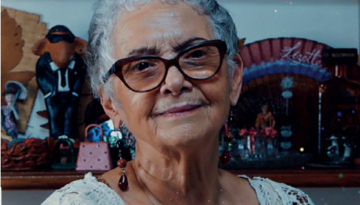
Inspired by real events, Después del final is an intimate portrait of the artist Luz Fernández de Castillo, whose journey fueled the fiction. Pablo César opts for a non-linear narrative: the story moves in a spiral, punctuated by flashbacks that illuminate the foundational moments of Gloria’s life. We discover her family relationships, her friendships, her artistic hopes, but also long periods of doubt. Gloria notably confronts writer’s block—an inner battle she tries to overcome by taking refuge in painting, poetry, or memories.
In this film where aesthetics occupy a central place, Pablo César skillfully blends plastic arts, literature, and philosophy. Numerous references, particularly to Plato, feed the contemplative dimension of the narrative. Poetry, omnipresent, acts as a vital breath that accompanies the protagonist in her creative impulses but also in her vulnerabilities. The director also calls upon major literary figures such as Oscar Wilde and Federico García Lorca.
The direction relies on a meticulous visual atmosphere, oscillating between reality and legend, between the concrete and the imaginary, and between black and white and color. This aesthetic reflects the finesse with which the interiority of an artist in the twilight of her life is cinematically rendered. The work concludes with a poignant scene: Gloria, now crowned with a form of late recognition, delivers a speech upon receiving a prestigious literary prize. Pablo César delivers a deeply human film, a tribute to the power of art and the strength of resilience.